

Xero is good accounting software. It wasn’t built for agencies.
Xero handles general bookkeeping well. Bank reconciliation, BAS, invoicing — for small businesses, it does the job. The problem for agencies is structural. Xero uses a Cost of Goods Sold (COGS) model designed for businesses that sell products. Agencies deliver time, services, and media across complex billing structures that a COGS model cannot accurately represent. As agencies grow, that mismatch compounds: revenue tied to invoice timing rather than work completed, WIP invisible, client profitability assembled in spreadsheets, and month-end close a two-week exercise in reconciling systems that do not connect.
Reviewing your systems this year?
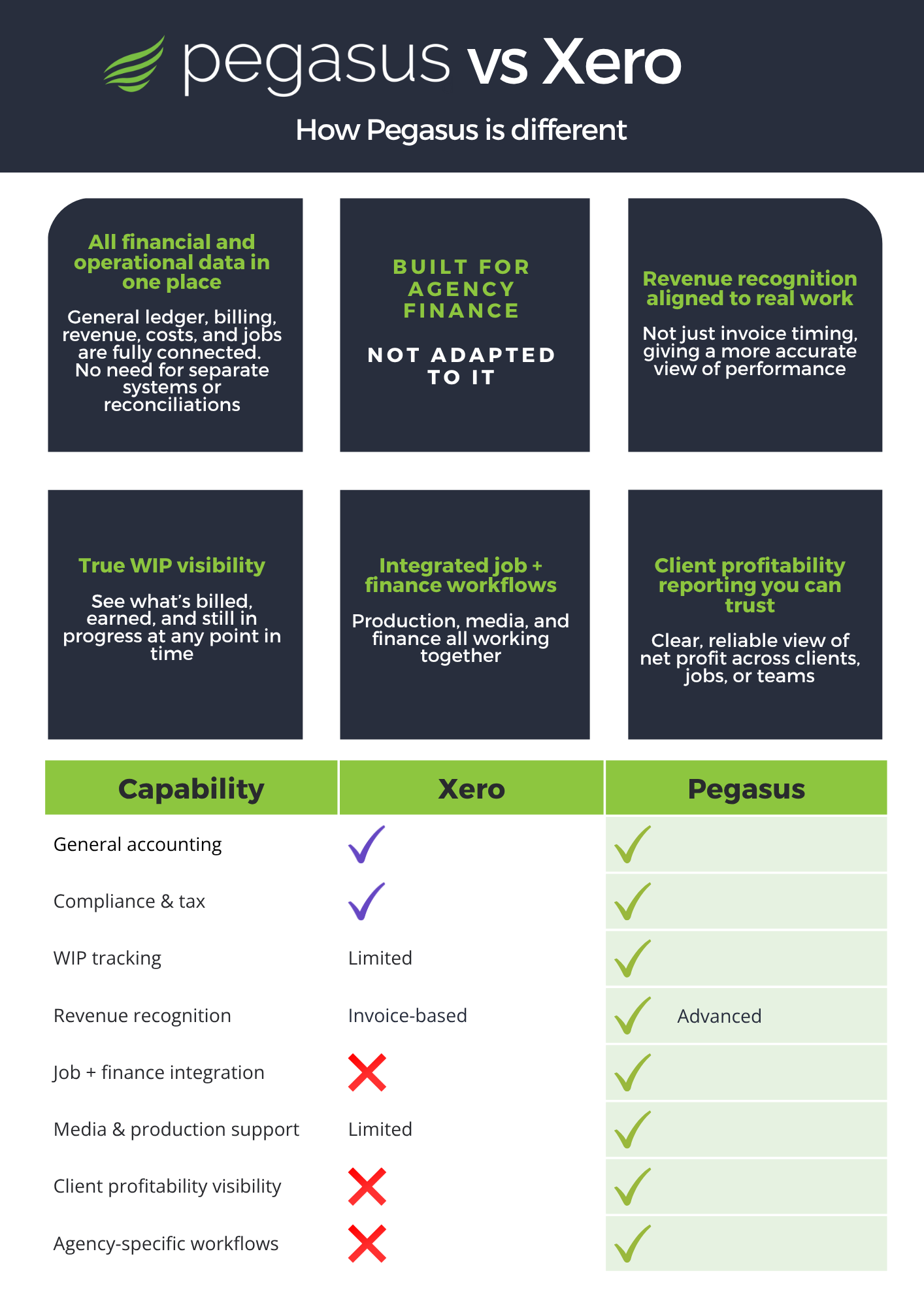
Fill in the form to download the Pegasus vs Xero guide. Written for finance directors and agency owners evaluating their options, not for people who have already decided.
“With just one month of going live, I’m fully up-to-date, which gives me time to be proactive rather than reactive. We have full visibility over job costs and billing status, reporting is accurate and insightful.”
Want more detail first? Read why agencies outgrow Xero →
What Xero does well
Xero is a strong general accounting tool. It handles day-to-day bookkeeping, BAS and compliance reporting, bank reconciliation, and standard financial reporting with minimal setup. For sole traders, small businesses, and early-stage agencies, it works well. This page is not about replacing bookkeeping. Pegasus supports everything Xero does in the general ledger and extends beyond that to what growing agencies actually need.
How Pegasus Edge is built differently
Pegasus Edge is a finance-first ERP designed specifically for creative, media, and full-service agencies. It does not adapt general accounting to an agency context — it starts from how agencies actually operate financially and builds from there.
See how Pegasus compares to general accounting tools →
How does Pegasus handle financial data across modules?
In Pegasus Edge, journals and financial entries populate automatically from connected modules. When time is logged, a job progresses, or a supplier invoice is approved, those events flow through to the general ledger without manual re-entry. The ledger reflects what is happening across the agency and is updated continuously.
How does Pegasus handle revenue recognition?
Pegasus Edge supports eight revenue recognition models, from conservative to real-time. Rather than tying revenue to invoice timing, finance teams choose the model that reflects how their agency earns. WIP updates as work progresses, and month-end reporting reflects the period accurately, not just what was invoiced.
How does Pegasus show client profitability?
Every job, timesheet, and supplier cost in Pegasus connects to a client. Net margin by client, job, product, team, or entity is a live report — not a spreadsheet exercise. Agencies can see which clients and projects are profitable while work is still in progress, not after it is delivered.
How does Pegasus handle bank reconciliation?
Pegasus Edge rebuilds bank reconciliation from the ground up with AI at its core. Bank transactions are automatically matched against the general ledger, with AI handling complex scenarios including fuzzy matches, recurring transactions, and multi-currency entries. The system learns from how your team works, improving accuracy over time. Exceptions are surfaced clearly so your team focuses on what needs attention, not every line.
How do automated bank feeds work in Pegasus?
Bank transactions flow directly into Pegasus Edge from your connected accounts, automatically matched against the general ledger in real time. There is no manual import, no reconciliation backlog, and no standalone ledger to maintain separately. Everything connects to jobs, profitability reporting, and cash flow visibility the moment it clears.
What does Pegasus support look like compared to Xero?
Pegasus provides direct access to a named support contact with agency finance experience — not a ticketing queue or callback system. Implementation is handled by a dedicated project manager who stays with the agency through go-live. It is a different model from general accounting software, built for a more complex transition.
Where agencies start to struggle with Xero
Why is WIP visibility limited in Xero?
Xero records transactions but does not track work in progress. Agencies can see what has been invoiced, not what has been earned against ongoing work. That gap means revenue figures lag reality until invoicing occurs, and profitability only becomes clear after the fact — when there is no longer an opportunity to act on it.
How does Xero handle revenue recognition for agencies?
Xero recognises revenue on the invoice date. For agencies managing retainers, project milestones, and media that span billing periods, this creates a consistent mismatch between what is billed and what has actually been earned. Finance teams compensate with spreadsheet adjustments that introduce delays and reduce confidence in the numbers.
Why is client profitability hard to see in Xero?
Xero does not connect job costs, staff time, and supplier invoices to produce a net margin by client. Seeing client-level profitability requires exporting data and assembling it manually — usually in Excel, usually after month-end — which means the insight arrives too late to influence decisions.
What do agencies say about Xero support?
Xero does not offer inbound phone support on any plan. All support is handled through Xero Central, email, and outbound callbacks. For agency finance teams managing a payment failure during month-end close or a reconciliation issue ahead of a tax deadline, async-only support poses a genuine operational risk.
When agencies typically make the switch
There is no fixed trigger point. Agencies typically start evaluating alternatives to Xero when:
Month-end close regularly takes longer than five working days
Finance cannot answer "what did we actually make on that client last quarter?" without a spreadsheet exercise
Revenue figures and profitability do not match because of WIP timing differences
Staff time is not connecting to job costs or client billing
The agency is managing media, production, and service work simultaneously, and the financial picture of each is unclear
Leadership needs reporting that reflects performance in real time, not invoicing history
What agencies report after moving to Pegasus
“Pegasus has helped us align our finance and media into a single, more accurate reporting model.”
Download the Pegasus vs Xero guide
This guide covers the structural differences between general accounting software and a purpose-built agency ERP — what changes when you move from invoice-based revenue recognition to real-time WIP tracking, and what the transition actually involves. Written for finance directors and agency owners evaluating their systems.
Frequently asked questions
Is Xero suitable for a growing agency?
Xero works well for agencies at an early stage or with simple billing models. As agencies grow — particularly those managing project work, retainers, media, and staff time simultaneously — Xero's invoice-based revenue model and lack of native WIP tracking create visibility gaps that become harder to manage with spreadsheet workarounds.
What's the difference between Xero and Pegasus Edge?
Xero is a general accounting platform designed for small to medium businesses. Pegasus Edge is a finance-first ERP designed specifically for creative and media agencies. The core difference is revenue recognition: Xero ties revenue to invoice timing; Pegasus supports multiple recognition models aligned to actual work completed. Pegasus also connects jobs, time, media, and finance in one system.
Can Xero handle agency job profitability reporting?
Not natively. Xero does not connect job costs, staff time, and supplier invoices to produce a client or job profitability figure. Agencies typically export data and build profitability reports in Excel, which introduces timing delays and manual error risk.
Does Pegasus replace Xero?
Pegasus replaces Xero as the core financial system for agencies that have outgrown general accounting software. It handles everything Xero handles in the general ledger, and extends into WIP, revenue recognition, job profitability, media management, and timesheets — all in one connected system. Agencies do not need Xero alongside Pegasus.
How long does it take to move from Xero to Pegasus?
Implementation follows one of two paths: Fast Start (two to four weeks for fresh setups) or Full Start (up to sixteen weeks for full data migration). A dedicated Pegasus project manager supports the process throughout. There is real commitment involved, particularly for finance teams adjusting to an accrual model, and the transition is worth it. See how Pegasus implementation actually works →
Does Xero have phone support?
Xero does not offer inbound phone support on any plan. Support is handled via Xero Central, email, and outbound callbacks. Pegasus provides direct access to a named support contact with real agency finance experience.
Not ready to download? Start a conversation instead.
If you're evaluating your systems this year, our team is happy to talk through whether Pegasus is the right fit.