

Time Tracking Isn’t Toxic. Bad Systems Are. How Agencies Can Use Time Data to Protect Margin (Without Burning Out Their Teams)
Time tracking isn’t the villain in agency life; the systems behind it usually are. The most profitable agencies aren’t apologising for tracking time; they’re simply doing it in a way that supports their team, protects margin, and gives them clarity instead of extra admin. In this blog, we explore how integrated time in Pegasus makes time tracking feel natural, not painful, while working beautifully alongside tools like Float for resourcing and planning.
Time tracking has become one of those hot-button topics in the agency world.
Some say it’s outdated.
Some say it’s punitive.
Some say their team “won’t tolerate” it.
…But the agencies growing profitably in 2025?
They’re tracking time.
Not as a stick.
Not as punishment.
Not as a daily ritual of guilt.
They’re tracking time because not knowing where your team spends its most expensive resource is like running a restaurant without tracking ingredients.
You don’t know when work is “running out.”
You don’t know what’s being wasted.
You don’t know where inefficiencies are hiding.
And you definitely don’t know which clients are quietly eating your margin alive.
The problem isn’t time tracking.
It’s the systems that make it painful.
Why Time Tracking Feels Toxic (Hint: It’s Not the Practice)
Most people don’t hate time tracking.
They hate:
Juggling multiple apps
Double-entering hours
Forgetting timers and rebuilding their day
Time that never connects to revenue, costs, billing, or job health
Not understanding why they track time
Managers using timesheets as a weapon instead of a lens
And honestly? Fair enough.
If your time data lives in a standalone tool with no connection to finance, resourcing, or job performance, it’s understandable that teams feel:
“Why are we doing this?”
Time tracking becomes toxic when the system makes the admin heavy… and the data meaningless.
Time Is Your Agency’s Raw Material
This is Nick Avaria’s point, and it’s bang on.
Agencies don’t sell widgets.
You sell expertise, creativity, strategy, and delivery, all powered by time.
Time tells you:
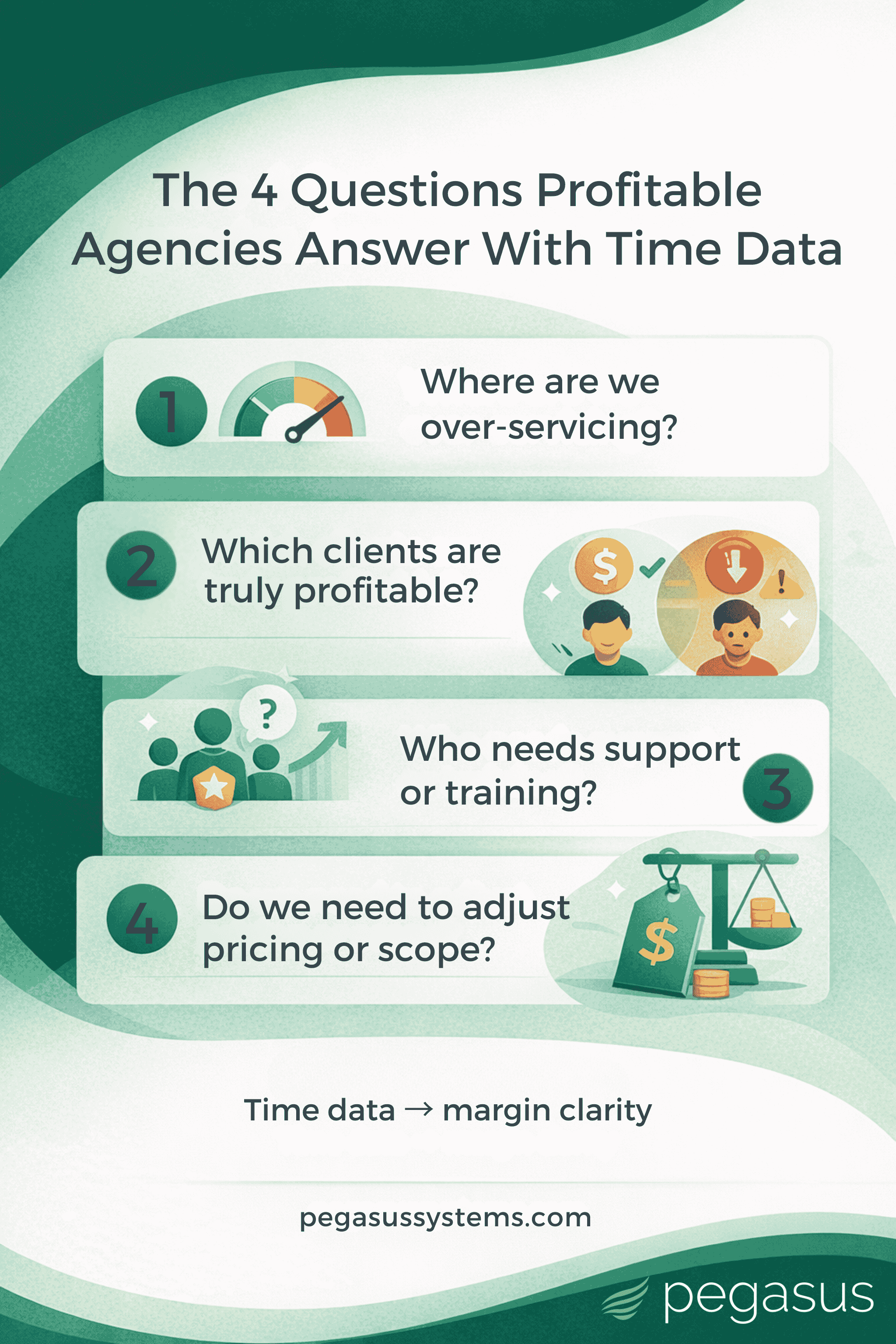
Where you're over-servicing
Whether a job is drifting off-track
Whether your pricing needs a tune-up
Where a team member might need support
Who’s over capacity
Who’s ready to take on more
Whether a client is profitable or quietly draining margin
If you can’t see where time is going, you’re running your agency by feel.
And feeling good doesn’t keep margins healthy.
Where Most Agencies Go Wrong
It’s not that teams refuse to track time.
It’s that systems make it:
Disconnected from jobs, revenue, and billing
Manual (hello, spreadsheets)
Inconsistent (two departments, three tools)
Invisible to the people who need insights most
Totally detached from forecasting and capacity planning
If your time tool can’t connect to the financial and operational parts of your agency, the data becomes shallow, all admin, no insight.
And that’s exactly why integrated time tracking inside your agency platform is such a game-changer.
Why Integrated Time Tracking (Like Pegasus) Changes Everything
When time tracking sits inside your agency system, everything is connected:
⏱️ Timers → Jobs → Costs → Revenue → Margin → Reporting
All in one flow. No double-handling. No copy/pasting. No tool-switching.
Suddenly, time data becomes:
Something your team doesn’t dread
Something your job managers can rely on
Something your finance team can trust
Something your leadership team can use to make strategic decisions
Pegasus turns time tracking into something that feels… easy.
Because it actually helps people.
Not just finance. Not just operations.
Everyone.
Some of the goodness included in integrated time:
Weekly entry views
Pre-filled tasks from jobs
Time that automatically updates job progress
Time that flows into revenue recognition
Real-time reporting on utilisation, cost, burn, margin, and job health
No extra tools needed — unless you want them 👀
Which brings us to Float.
Pegasus + Float: A Dream Team for Agencies
Let’s be clear. We don’t believe every agency should live in one mega-tool.
If you love using Float for planning and resourcing, fantastic. It’s one of the best tools in the industry for visual capacity management.
And Pegasus integrates beautifully with it.
Here’s the healthy ecosystem:
Float → Forecasts resourcing, capacity, availability, upcoming work
Pegasus → Gives you actual time, actual cost, actual revenue, and actual job health
Float helps you plan.
Pegasus tells you what actually happened.
It’s the perfect pairing:
Future + actuals = real clarity.
No tool rivalry.
Just alignment.
What Agencies Unlock With Integrated Time
Once time is part of the whole system, everything sharpens.
1. Margin clarity
You know the real cost of every client and job.
2. Early warning signs
Over-servicing isn’t discovered 8 months later. It’s spotted in week 2.
3. Workload protection
Time data shows when teams are overloaded long before burnout kicks in.
4. Training opportunities
See where inefficiencies cluster and where support is needed.
5. Better pricing decisions
Your pricing reflects reality, not guesswork.
6. More accurate scoping
Future projects become more profitable because past data finally speaks.
7. Healthier forecasting
Integrated time → integrated actuals → smarter future decisions.
How to Keep Time Tracking Non-Toxic
This section is key. Time tracking is only scary when people don’t understand how the data is being used.
Healthy agencies use time as a lens, not a stick.
Try these philosophies:
✔️ Use time to protect capacity, not stretch it
✔️ Use time to improve processes, not blame individuals
✔️ Use time to support transparency, not micromanagement
✔️ Show teams how time recording leads to better scoping, fairer workloads, and fewer 6 pm surprises
Time becomes a tool for clarity, not control.
Ready to make time tracking painless, and finally see where your margin is really going?
Let’s book a demo.
Q&A
Do modern agencies still track time?
Yes. The profitable ones do. Time is your raw material, and without visibility, margin leaks go unnoticed.
Is time tracking outdated or old-school?
Not when it’s integrated. Standalone timesheets feel outdated. Integrated time inside Pegasus feels natural to workflows and jobs.
How does Pegasus make time tracking easier for teams?
Timers, weekly entry views, pre-filled job tasks, and no double entry. It’s built into everyday job workflows.
Can I use Float and Pegasus together?
Yes. Float handles planning. Pegasus handles actuals. The integration gives you the best of both worlds.
What if my team hates time tracking?
They usually hate the tool, not the concept. Integrated time removes admin pain and makes the data meaningful.
How does integrated time help agencies scale?
Time → cost → revenue → margin → reporting. When those pieces connect, agencies scale without chaos.
Why is time data critical for client profitability?
You can’t understand cost, margin or over-servicing without knowing how long work actually takes.